Burry has been right most of the time, except for the exact timing, which is indeed mission impossible.
Category: Value Investment
The very question you should ask yourself among AI Bubble
The very question you should ask yourself at this moment is, in which way an enterprise can win big and build a wide enough moat by using AI, just like those successful companies build their dominating business on the Internet in the last few decades.
Visa will be the winner in the long term
Visa will be the winner in the long term, because it will contain stablecoin within its ecosystem, although this has some impact on Visa’s margin in the short term.
https://finance.yahoo.com/m/bdfe4895-4c8f-384f-aa08-0470646ffe7c/visa-launches-stablecoin.html
Should Investors Believe Musk
If Musk has so much confidence in the future of Tesla, he should buy more Tesla’s shares using his own money instead of demanding a trillion dollar pay package. After having been failed to deliver a full self-driving car for 9 years, I have a strong reason to doubt whether Musk will deliver his promises in future.
Are You Greedy Now
If you are a serious investor, you must have heard of the famous Buffett saying, “Be fearful when others are greedy. Be greedy when others are fearful.” Well, it’s easy to understand the idea, but very difficult to practice. The key is “when”.
Let’s look at the movement of index fund “QQQ” during the year-to-date bear market, there were two big rallies, only to lose ground to go further down again.
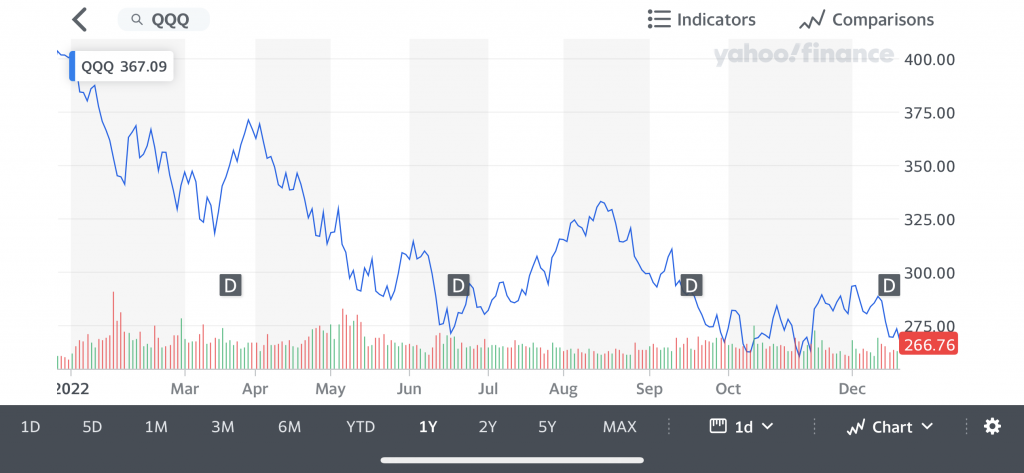
If you were greedy around mid March, you would have enjoyed a good rally, only to give back and fall further down later. The same scenario would happen again in July. Obviously, there were quite many people being greedy to have a good rally in a bear market, while there were even much more people being fearful in the first place to have a lasting bear market.
It seems that the winning formula “Be greedy when others are fearful”, doesn’t always work. If you became greedy too early while more people kept turning fearful, the market went down, even with much more people having turned fearful earlier. Only when the power of fearful is near exhaustion, the greedy side has the chance to win.
How do you know how many percent of people in the market being fearful? To be more accurate, you need to know the percentage of capital controlled by these people on the fearful side. If that percentage was over 90%, your greediness would win huge, simply because downward power of the market is near exhaustion.
However, there are no such market statistics available. You have to rely on your gut feeling. But gut feeling is not reliable. The next thing is the chart. By looking at the chart above, you might think QQQ already reach the bottom at early Nov, which is showing a quite strong signal until the chart of coming 3 months telling you otherwise, because if a recession came in 2023 and lasted longer than the market having expected, all the stocks and indexes would go down further. Although almost everybody is talking about recession this time, no one for sure whether it will really come and how sever it will be.
Only one thing for sure: Nobody knows where the bottom is. The only reliable indicators I learned from my almost 20 years of investment experiences are the valuation results based on fundamentals. If you look at the PE for QQQ on Yahoo Finance, it is 22. Based on QQQ’s historical data, PE at 22 is cheap. But you cannot analyze QQQ like an actual company and cannot tell whether companies included in QQQ will survive in a recession. I eventually bought Microsoft in early Nov at $215 simply because Microsoft is a tech blue chip and it will most likely not only survive a recession, but thrive when everyone is struggle to “achieve more” with less. And most importantly, I could analyze it as a company with all the data available and concluded that it’s cheap at $215 with enough margin of safety.
Since then, the market has been fluctuated wildly. However, price of Microsoft has gone up 12% since 8 Nov while QQQ has dropped back to the same price level. Obviously, there are many investors have reached same conclusion on the value of Microsoft in the market, while it’s difficult to evaluate an index fund like QQQ, which is much more affected by the outlook of economy development in near terms.
In short, valuation is the No. 1 factor to make investment decision. Greed and fear in the market only helps you to get better prices.
The Characteristics of A Successful Investor
I am one of the many students of Warren Buffett and quite successful in applying his investment methodology and philosophy,although he never knows me. Mr. Buffett once mentioned that investment is not rocket science and you don’t need a very high IQ to do it. That said, with 18 years of experiences in practicing value investment, I think that it’s not a job an average person can do it, and takes certain level of high IQ, wisdom, and certain characteristics to do it constantly well in a life time.
Self-Discipline
As a Buffett style value investor, you must have the self-discipline to follow the rules set based on your understanding of Buffett’s methodology all the time. This is easier said than done. Fear and greedy often affect your decision making and taking action decisively. There were many times I missed the best prices to buy or to sell and then waited for the best prices to back again for fearing of losing money or just being greedy, and missed the whole opportunity forever.
Continue reading “The Characteristics of A Successful Investor”The Didi Phenomenon
What happened to Didi could happen to any company in China. The fundamental reason behind is not what Didi did, but the political and economical system in China. It’s not a market economy in China. There is no rule of law, but rule by official power, or by the ruling party in China. In fact, the party can cut the throat of any company at will.
What happened to Didi is not the first case, as the case for Alibaba is still fresh in our memory, and will not be the last case. This is another wake up call to the everyone living in the free world and taking freedom and rule of law as granted. Without systematic change in China, the drop in share prices of Didi or Alibaba is NOT temporary, and therefore not an opportunity for investors to pick up the shares.
The US regulators and administration should ban the public listing of Chinese companies or any company which generate its revenue mainly from a country where there is no rule of law to protect investors.
Privacy on Facebook
I have heard all the fuss about privacy on Facebook in recent years and am still wondering what kind of privacy these people have been so seriously complaining about. In the internet and telecommunication era, you expose your location once you turn on your device connecting to the Internet or mobile networks. You also expose your interests every time when you click on a link or type a word on your device. The search engines or the APPs, including Facebook, you often used would eventually know your interests and preferences.
However, these kinds of information are nothing related to your social security numbers, your bank account details or your assets, and of course not the shape of your private part, if you are always careful enough not to expose them on the Internet.
But why are there so many people care so much about it? It’s really beyond my keen. I don’t care if someone knows that I like black chocolate, or beautiful girls either naked or not. It would be nice, if Google or Facebook could provide such information proactively. The trade off between my personal preferences and a free service like Facebook is well worth it!
BTW, Facebook has been the my best idea for investment among big tech companies since 2017.
What to do now
It’s a most turbulent and unique period for every investor. Even Warren Buffett never has such experience over his very long and successful career as the most respected investor in the world. He has not made any drastic move and is sitting on $137 billion dollar cash pile, except selling all the airline shares. There are a lot of people thinking he is too old to make any smart move quickly, and they can outsmart him. The wild fluctuation of certain shares, such as Hertz and airlines, which were impacted severely by the pandemic, are the evidence of active trading by these people.
The reality is that nobody is able to predict the near further precisely. Will the pandemic be over next month, quarter, or even next year? Will there be 2nd wave of sudden increase of hundreds and thousands infected people? How sever the impact of shutdown of most of economic activities caused? How fast will the economy pick up? Nothing is for sure. A pandemic like this has never happened in modern era. The only thing Warren Buffett being sure was that the airline would not be able to recover for next 2 to 3 years and the whole industry will not be the same again.
So, what to do now?
Continue reading “What to do now”Don’t Panic
A friend called me yesterday, asking what happened to my holdings in US shares. This is a normal reaction of ordinary people after a stock market crash anywhere.
My answer was, “Well, the shares indeed dropped a lot. But I never doubt the US will still be the most prosperous country in the world in next few decades.”
I always buy shares of public companies like an entrepreneur buying a business. The most important criteria I have been using to screening companies is always their competitive advantage and how wide the moat of the business is. The 2nd criteria is the health of the companies’ balance sheets. I never buy shares of a company carrying debt far more than its equity no matter how good its business looks like. Of course, even with such stringent screening criteria, there are still risks to loss my money. There is no such things as ZERO risk in the investment world.
However, unless human civilization were totally destroyed by a catastrophe, such companies would certainly not only survive, but rise from the dust and become even stronger. I have never doubted about that. COVID-19 pandemic is not that kind of catastrophe for sure. With the advanced medical technology at genetic level, it will be all over within 2 years time. In addition, its death rate is actually lower than 3% if all every infected person has been included in the data analysis.